

Seven patterns leaders can recognise early
Many diagnostics startups do not stall because the underlying science is fundamentally weak.
They stall because the path from a promising technology to a robust product is more complex than expected. Scientific progress continues, prototypes improve and teams remain busy, yet the company gradually loses momentum.
Timelines slip, priorities multiply, investors become less confident and development starts to feel increasingly difficult to control. In most cases, this does not happen because of one major mistake. It is the result of several structural problems that reinforce each other over time.
Having worked across diagnostics, life science tools, product development, system engineering and venture leadership, I have seen the same patterns repeatedly.
They are often visible long before a project reaches a critical point.
The following seven warning signs are particularly important.
1 The technology is treated as the product
A technology can work and still be far away from becoming a product.
A successful experiment, a promising assay or a functional prototype may demonstrate scientific feasibility. It does not yet prove that the solution can be used reliably, manufactured consistently, supported economically or integrated into a real customer workflow.
This distinction is frequently underestimated.
Teams often continue optimising technical performance while fundamental product questions remain unanswered:
- Who will use the product?
- In which workflow?
- Under which operating conditions?
- What level of performance is actually required?
- Which limitations are acceptable?
- What will the product cost to manufacture and support?
When technology and product are treated as the same thing, development decisions become reactive. The team improves what it can measure instead of building towards a clearly defined product.
The result is often a sophisticated technology without a sufficiently clear route to market readiness.
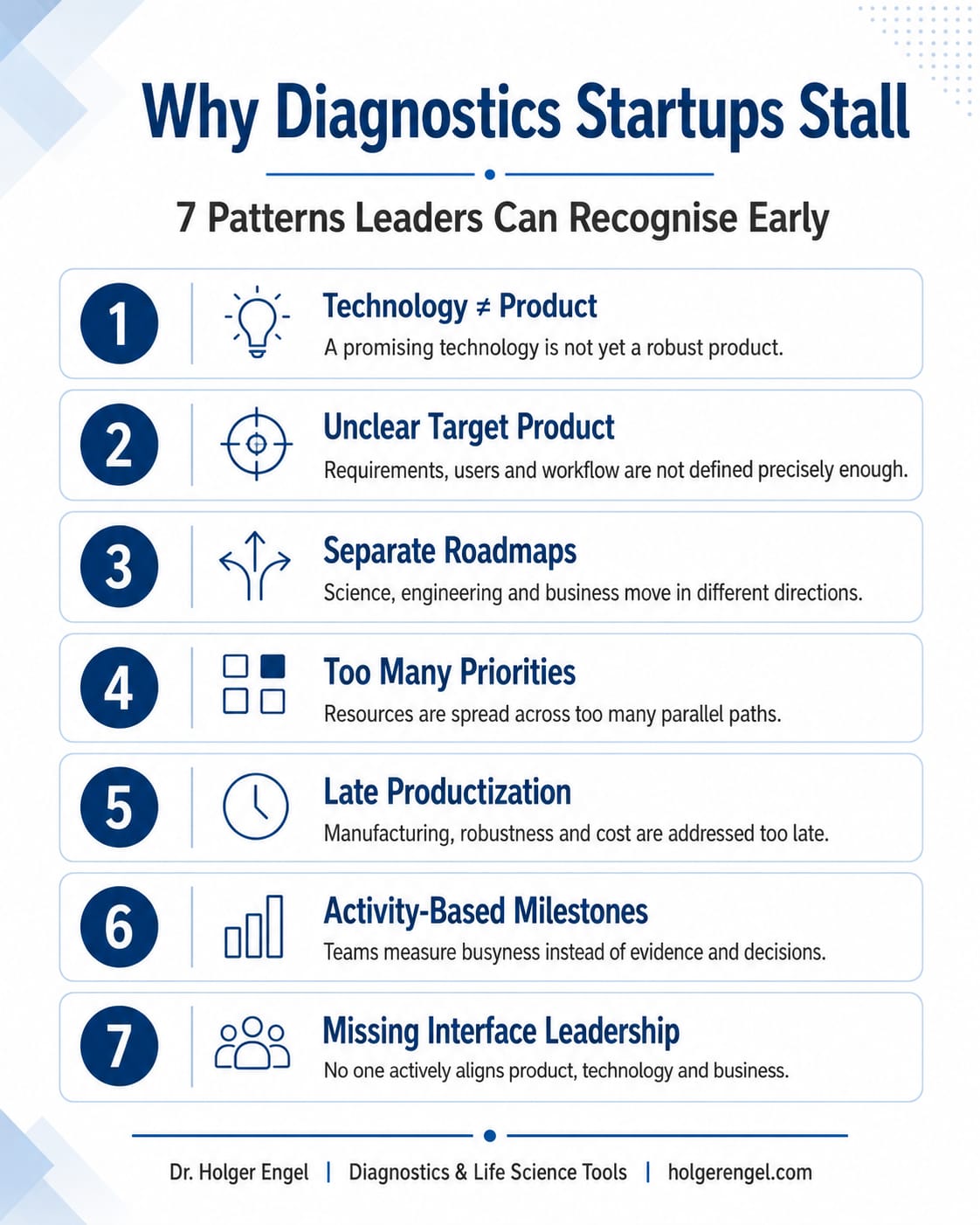
2 The target product is not defined precisely enough
Many development programmes start with a broad product vision but lack a sufficiently detailed target product definition. Statements such as “rapid”, “automated”, “low-cost” or “easy to use” sound clear, but they are not yet development requirements.
- How rapid is rapid enough?
- What level of automation is essential?
- What cost is acceptable?
- Which customer segment comes first?
- What performance is required for the intended use?
Without clear boundaries, every department interprets the future product differently.
Scientists optimise assay performance. Engineers optimise technical elegance.
Business teams discuss different customer groups. Investors hear a broader story than the development team can realistically deliver.
This lack of precision creates hidden divergence.
A strong target product profile does not need to answer every question at the beginning.
But it must establish enough direction to support prioritisation, system architecture and evidence-based decision-making.
3 Science, engineering and business operate on different roadmaps
Diagnostics development is inherently multidisciplinary.
Assay development, fluidics, instrumentation, software, manufacturing, quality, regulatory strategy and business planning cannot be managed as independent workstreams for long.
Yet this is exactly what often happens.
Each team progresses according to its own logic. Scientific teams focus on analytical performance. Engineers focus on technical feasibility. Business teams prepare market narratives and fundraising milestones. All three may appear productive, but the overall programme lacks integration.
The problem becomes visible when dependencies are discovered late.
A change in assay requirements affects cartridge design. A manufacturing constraint limits reagent choices. A user workflow requires software changes. A new market assumption changes the required throughput or cost structure. The central question is therefore not whether each function performs well.
The question is whether all functions are working towards the same product.
This requires active translation between science, engineering and business. It also requires someone who can identify conflicts early and convert them into clear decisions.
4 Too many priorities remain active for too long
Startups naturally want to preserve options.
There may be several possible applications, customer segments, assay menus, hardware concepts or partnership routes. Keeping alternatives open can be useful in the early phase.
But it becomes dangerous when the company avoids narrowing its focus.
Limited resources are then distributed across too many development paths. Teams continue work on multiple concepts because no one wants to close a potentially valuable option. Progress appears broad, but depth is missing.
This often creates three consequences:
- Critical experiments take too long.
- Decision-making becomes politically difficult.
- The development programme loses a clear centre of gravity.
Strong leadership is not only about creating new opportunities. It is also about stopping activities that no longer support the primary objective.
A startup does not need to solve every future problem at once. It needs to generate the evidence required for the next critical decision.
5 Productization starts too late
Productization is often treated as the phase that begins after the technology is “finished”.
That is usually too late.
Robustness, manufacturability, tolerances, supplier dependencies, quality control, serviceability and cost of goods are not downstream details. They influence fundamental design decisions.
A laboratory process may depend on highly skilled handling. A prototype component may work well but be unsuitable for scalable production. A reagent may perform under controlled conditions but be too sensitive to storage, transport or manufacturing variation.
If these issues are only addressed after the core system has been defined, redesign becomes expensive and timelines expand.
Productization should therefore begin much earlier.
This does not mean building a final manufacturing process during the proof-of-concept phase. It means recognising the future constraints of the product and incorporating them into development decisions from the beginning.
The best technical solution is not always the best product solution.
6 Milestones describe activity rather than evidence
Development roadmaps often contain many activities:
- build prototype,
- run study,
- optimise assay,
- start transfer,
- prepare regulatory strategy,
- meet potential partners.
These activities may all be necessary, but they do not automatically define progress.
A strong milestone should clarify what evidence will exist afterwards and which decision that evidence will enable.
For example:
- Has the critical technical risk been reduced?
- Has the system reached a defined level of reproducibility?
- Has the intended workflow been validated with representative users?
- Has manufacturing feasibility been demonstrated?
- Has the product concept met the agreed cost target?
- Is the company ready to commit to the next development stage?
When milestones focus mainly on work performed rather than knowledge gained, teams can remain busy without materially reducing uncertainty.
This is especially dangerous in fundraising situations.
Investors are less interested in the number of activities completed than in whether the company has increased the probability of successful execution.
7 Senior leadership is missing at the interfaces
Many startups have strong specialists.
They may have excellent scientists, capable engineers and committed business leaders.
Yet the company still struggles because the most important problems sit between disciplines.
No single function fully owns questions such as:
- Is the product concept technically and commercially coherent?
- Which risk should be addressed first?
- Are the development priorities aligned with the financing strategy?
- Is the team building the right evidence for investors and partners?
- Are manufacturing and regulatory constraints influencing design early enough?
- Is the organisation ready for the next stage?
These are interface questions.
They require experience across functions and the authority to create alignment.
Not every startup needs a full-time senior executive at every stage. But it does need access to experienced leadership that can challenge assumptions, structure decisions and help the team move from discussion to execution.
This can take different forms: an interim role, a fractional leadership position, a strategic sparring partner or a focused project engagement.
The format is less important than the ability to connect technology, product, organisation and business reality.
Stagnation rarely starts with one dramatic failure
Diagnostics startups usually do not stall overnight.
The warning signs appear gradually:
- development takes longer than expected,
- priorities become less clear,
- interfaces become more difficult,
- roadmaps become more complex,
- investor questions become harder to answer,
- the team remains active but progress feels less tangible.
At this point, the instinct is often to add more activity.
More experiments.
More meetings.
More people.
More parallel workstreams.
But the more effective response is usually to create clarity.
Leadership teams should ask:
- What is the product we are actually building?
- Which evidence do we need next?
- What are the most critical technical and organisational risks?
- Which activities can be stopped?
- Where are the interfaces not being actively managed?
- Which decisions are being postponed?
- Who owns the overall product logic?
The answers are rarely purely scientific or purely commercial.
They sit at the intersection of science, engineering, business and execution.
That is also where experienced external support can create the greatest value.
I work with founders, development teams and investors in diagnostics and life science tools to identify development bottlenecks, structure complex programmes and move technologies towards robust products and viable ventures.
If you recognise some of these patterns in your own organisation and would like to discuss them, contact me at info@holgerengel.com, send me a Whatsapp at +4915256345688 or connect with me on LinkedIn.